

Lampadaires (2) – Place Vasileos Georges A – Patras
Monumen
Photo Gallery
|
|
Additional Info
| Sculpteur 1 | NON CONNU |
| Sculpteur 2 | NON CONNU |
| Sculpteur 3 | NON CONNU |
| Fondeur | DUCEL |
| Architecte | NON CONNU |
| Editeur | NON CONNU |
| Adresse ou lieu-dit | Place Vasileos Georges A |
| Pays | Greece |
| Continent | Europe |
| Latitude | 38.246586 |
| Longitude | 21.734617 |
| Planche Volumen | DUC_VO_PL432_F216 |
| Matériau | Fonte |
| Type d'oeuvre | Lampadaires - torchères - candélabres |
| Année | 1874 |
| Titulaire(s) et droits sur les photos | Panagiotis Anthopoulos and Nikolaos Tzanakos |
Description de l'objetLampadaires (2) |
HistoriqueAn historical journey with known and unknown versions of the evolution of Patras Greece during the 19th century. Starting point and the grand protagonist: King George’s A’ square. The heart of the city was and is still beating there . By imprinting the evolution of George’s square, we practically cover the total course of history in Patras and grasp the reasons that allowed Patras to become a great city and to follow such an incredible path. Looking carefully and for the first time the creations that compose the majestic fountains and many other details around the square , we can perceive, with splendid accuracy, the myths and traditions that influence the city. Some of these myths originate from ancient Greece and others were born during the first years of the greek nation. |
Référence sourceNikolaos Tzanakos : Patras 19th century: A plaza–myth in an international city, Patras 2014 |
Bibliographie et liensNikolaos Tzanakos: Patras 19th century: A plaza–myth in an international city, Patras 2014 http://www.tempo24.gr/…/i-istoria-poy-einai-dipla-mas-alla-… |
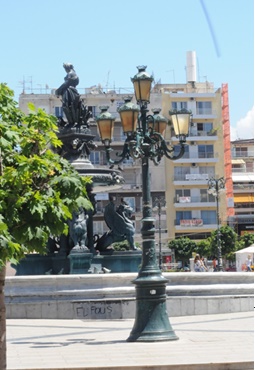
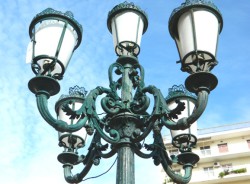
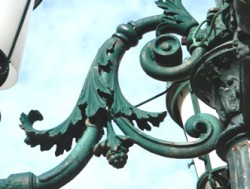
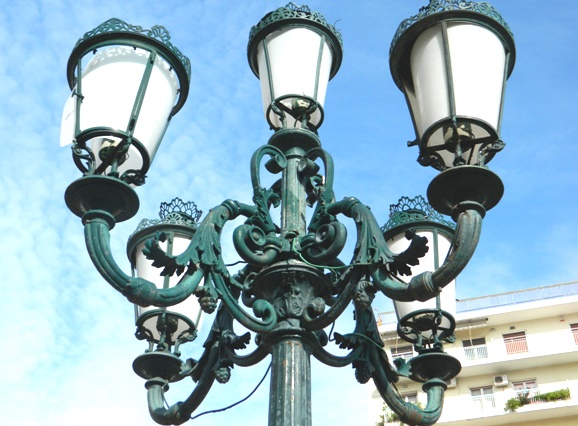
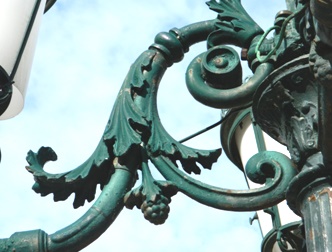
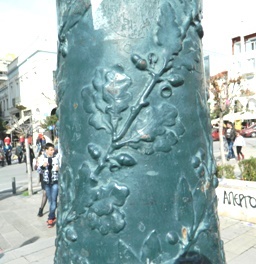
Deux lampadaires français de J.J. Ducel et Fils, à Patras
Modèle sur la planche surchargée par le Val d’Osne après 1879 : DUC_VO_PL432_F216 – Candélabres, consoles et lanternes
Sur la place George A’, existent, sauvegardés, deux des huit lampadaires de la société française, J.J. Ducel et Fils, qui ont été placés en 1874, sur la place à Patras (Grèce). Les lampadaires ont été placés au moment où la place a été aménagée ; là, sont placées deux fontaines célèbres de Ducel. Il a été décidé d’éclairer la place avec des lumières de gaz et tout de suite les lampes pour l’éclairage ont été achetées, dont huit très chers. Au total, à Patras, il y a plus de 20 de ces lumières, avec 5 lampadaires sur 4 grandes places de la ville. Des photographes de cette époque subsistent encore préservées. Il s’ agit vraiment d’art de fonte fabriqué dans les fonderies de fer de Ducel, en France. On peut trouver ces projets dans les listes de la société J.J. Ducel et Fils.
Commentaires