

Ibrahim Pacha – Musée militaire – Citadelle – Le Caire
Monumen
Photo Gallery
|
Additional Info
| Sculpteur 1 | CORDIER Charles Henri Joseph |
| Sculpteur 2 | JACQUEMART |
| Sculpteur 3 | NON CONNU |
| Négociant - Distributeur | NON CONNU |
| Technicien | NON CONNU |
| Paysagiste | NON CONNU |
| Fondeur | THIÉBAUT |
| Architecte | NON CONNU |
| Adresse ou lieu-dit | Musée militaire Sharia Salah Salem Citadel |
| Localité | Le Caire |
| Pays | Egypt |
| Continent | Afrique |
| Matériau | Bronze |
| Type d'oeuvre | Monuments aux grands hommes |
| Morphologie | statue équestre |
| Année | 1871 |
| Titulaire(s) et droits sur les photos | Source : Web |
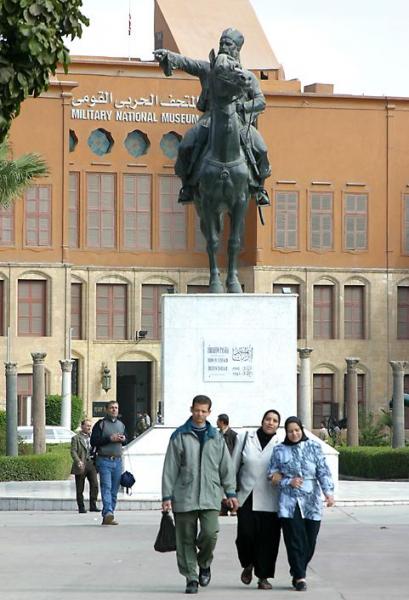
HistoriqueLe monument est le double de la statue Midan Opera. Nous n'avons pas de précision sur la date de l'exécution de la statue (en même temps que la statue de la place de l'Opéra ou après ?) Par rapport à la version du centre ville, les bas-reliefs n'existent pas. The Egyptian National Military Museum is located within the Cairo Citadel, a walled complex of fortifications and various types of buildings which is on a promontory overlooking Cairo. When you enter the museum area you'll see this statue of one of Egypt's historic military heroes called Ibrahim Pasha, who was the son (possibly adopted) of Muhammad Ali, who is generally considered the founder of modern Egypt. Muhammad Ali and Ibrahim Pasha weren't Egyptian by birth, they both came from a part of the Turkish Ottoman empire which is now within the borders of Greece. About 20 years after Muhammad Ali became ruler of Egypt he sent Ibrahim Pasha in an ill-conceived attempt to put down a native Greek rebellion which was being supported by Great Britain, France and Russia. Against Ibrahim's advice, he was ordered to join battle against the combined navies of the European powers, and the entire Ottoman fleet was destroyed. Ibrahim had considerably more success fighting against the Wahhabis in the Arabian peninsula (though the unpleasantly rigid Wahhabi brand of Islam is now dominant in Saudi Arabia), and he also did very well fighting against the Ottomans in Syria. However, continual interventions by European countries prevented him from making lasting conquests, and he eventually retreated to Egypt, which he ruled briefly before his death in 1848.ox. Although he wasn't really Egyptian, and although he certainly had his failures, Ibrahim's successes make him an appropriate candidate for national hero in Egypt. He certainly looks noble up on his horse, but contemporary accounts describe him as short, very obese and deeply scarred by smallp |
Ibrahim Pacha: statue équestre par Jacquemart (pour le cheval) et Cordier (pour le personnage) (bronze fondu par Thiébault).
Commentaires